You might also be interested in this:

Online shop or marketplace: Advantages and disadvantages for B2B companies
Digital transformation has fundamentally changed B2B commerce. Companies today face the crucial question: Should they sell their products via their own online shop or established marketplaces? This strategic decision significantly influences business success and long-term market positioning.
In this article, we examine and compare both approaches – own online shop and marketplace – based on opportunities, risks, and typical use cases. We begin with a look at the current market situation:The German B2B e-commerce market is experiencing continuous growth of 6.6 percent to €1.54 trillion [1]. The development of online shops and marketplaces is particularly noteworthy, as they are growing significantly faster than traditional EDI systems. These figures illustrate the steadily increasing importance of digital sales channels for B2B companies.
Own online shop – Complete control over brand identity
Advantages of Your Own Online Shop
- Brand Control and Differentiation
An online shop of your own offers companies complete control over their brand presentation. They can design the layout, user interface, and the entire customer experience according to their own vision. This autonomy makes it possible to establish a distinctive brand identity and clearly differentiate themselves from the competition. - Long-Term Cost Efficiency
Although the initial investment for an online shop is substantial, lower operating costs can result in the long run. Companies save on marketplace transaction fees and retain complete control over their pricing strategy. - Direct Customer Relationships
An online shop of your own enables direct contact with customers and the collection of valuable data about their behavior and preferences. This information is crucial for developing targeted marketing strategies and product optimizations. - Integration with PIM Systems
An online shop offers ideal opportunities for integration with Product Information Management systems. This connection enables centralized management of all product data and ensures consistent, high-quality product information across all channels.
Recommended Reading: The 5 Benefits of a PIM System for Your B2B Online Business
Challenges of Your Own B2B Online Shop
- High Initial Investments
Developing and operating a professional online shop requires a significant investment of budget and resources. In addition to the platform, hosting, and security, integrations with ERP and PIM systems, as well as ongoing maintenance and development, are necessary. Marketing budgets are also required to systematically build visibility and brand awareness. - Time-Dependent Reach Building
Without existing platform reach, demand develops gradually. Organic visibility requires consistent search engine optimization, a clear information architecture, and relevant content; paid measures and sales involvement increase the effect but take time. Continuous management and optimization along the customer journey create predictable results.
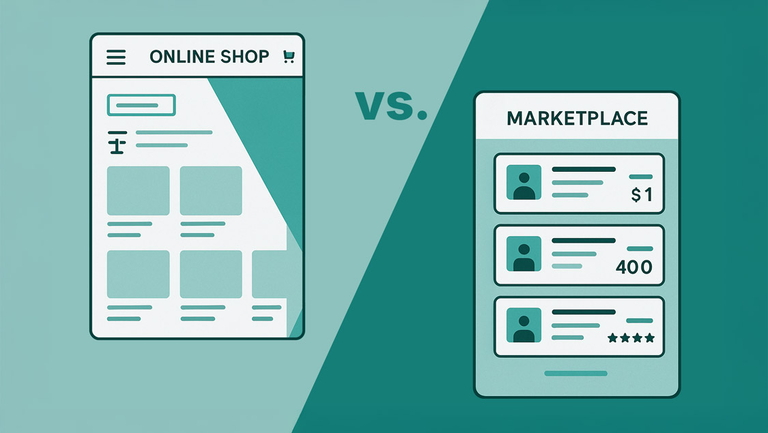
Marketplaces – Fast market access with proven infrastructure
Advantages of B2B Marketplaces
- Immediate Market Presence
Marketplaces like Amazon Business or Alibaba.com offer companies immediate access to an established user base. These platforms have already gained customer trust and have proven payment and logistics systems. With the Amazon Connector, you can seamlessly connect Amazon Business with Microsoft Dynamics 365 and your PIM. Product data, prices, and inventory are automatically synchronized, and orders flow directly into the ERP system. This shortens time to market and ensures a consistent customer experience across all channels. - Faster Return on Investment (ROI)
Thanks to low initial investments and immediate visibility, companies can achieve a positive ROI more quickly on marketplaces. Half of all e-commerce purchases in the DACH region are already processed via marketplaces [2]. With the ESYON Amazon Connector, you reduce manual maintenance, minimize errors in offer creation, and accelerate the listing of new product ranges and country markets. This allows you to achieve results faster and create a solid foundation for scaling. - Reduced Technical Complexity
Marketplaces handle the technical infrastructure, payment processing, and often logistics as well. This allows companies to focus on their core competencies instead of dedicating resources to technical development. The Amazon Connector provides additional relief: attribute and category assignments, offer and variant creation, order import, and tax and shipping logic are all managed centrally in Microsoft Dynamics 365. Configuration instead of custom development reduces implementation risks and increases scalability, even for multiple marketplace accounts.
Disadvantages of Marketplaces
- Limited Brand Control
On marketplaces, companies are subject to the platform's design guidelines. Products are often presented directly next to competitors' products, which makes differentiation difficult and can lead to intense price competition. - Limited PIM Integration
The integration of PIM systems into marketplaces is often limited. Companies must adapt their product data to the specific requirements and formats of the respective platform, which can lead to inconsistencies and increased maintenance efforts. - Dependence on Third Parties
Companies are dependent on the decisions and changes made by marketplace operators. Algorithm changes or new fee structures can have an immediate impact on business success. - Ongoing Transaction Costs
Marketplaces continuously charge fees for transactions, which can negatively affect profit margins in the long run. As sales volumes increase, these costs can become substantial.
Decision criteria for the right strategy
The choice between your own online shop and a marketplace depends largely on four factors. First, company size and resources play a central role: Smaller companies often benefit from the rapid market penetration offered by marketplaces, while larger companies with sufficient budgets benefit from their own shop in the long run. Second, the industry and target group influence the decision: In specialized niches, the flexibility of an in-house shop is advantageous for handling complex configurations and individual requirements; standardized product ranges are well-suited to marketplaces.
Third, product complexity affects the choice of channel. Extensive catalogs and complex product data require a seamless connection between the online shop and a PIM system to manage information efficiently and reduce errors. Fourth, long-term business goals dictate the direction: Those who want to build a strong brand identity rely on their own shop; those who want to scale quickly and tap into new markets leverage the reach of marketplaces.
Hybrid approaches – the best of both worlds
Many successful B2B companies pursue a multi-channel strategy that includes both their own online shops and marketplaces. This approach makes it possible to leverage the advantages of both channels:
- Marketplaces for rapid market entry and increased reach
- Own online shop for brand control and direct customer relationships
- Central PIM systems as a data source for both channels to ensure consistent product information
The decision between a company's own online shop and a marketplace is therefore complex and far-reaching. Every company faces individual challenges that require a tailored solution. Factors such as existing IT infrastructure, integration options with ERP systems, Microsoft Dynamics 365, or PIM solutions must be carefully analyzed.
Eine fundierte Entscheidung erfordert die umfassende Bewertung aller relevanten Aspekte:
- Technical Integration: Analysis of the existing system landscape and integration options
- Scalability: Assessment of long-term growth potential
- Cost Analysis: Comparison of initial investments and ongoing operating costs
- Market Positioning: Development of a coherent digital strategy
Fazit: Eine strategische Entscheidung mit weitreichenden Konsequenzen
The choice between your own online store and a marketplace depends on various factors: company size, available resources, industry, and long-term goals. While marketplaces offer quick market access and lower initial investments, your own online stores allow for complete brand control and direct customer relationships. However, hybrid strategies that intelligently combine both channels can also be useful, depending on the company's strategy. Continuous evaluation of market developments and technological trends is crucial for long-term success in digital B2B commerce.
Due to the complexity of this decision, ESYON supports you with sound, practical advice. We analyze your digital sales and system landscape, evaluate the options between your own online shop and marketplaces, and design a suitable integration architecture for Microsoft Dynamics 365, ERP, and PIM. This provides you with a robust, data-driven basis for decision-making and enables you to implement prioritized measures efficiently and scalably.
Sources:
[1] EHI Retail Institute: The German e-commerce market is expected to grow to 1,54 Billionen Euro (2024)
[2] Shopify: The German e-commerce market is expected to grow (2024)