
A translation icon hovers above a smartphone. Above it are further icons for documents, shopping carts, and magazines.

Steffi Favetto 7 Minutes

Scaling Shopware Multilingually with Perfion PIM and Clean Product Data

Contents

Maintaining product data in five systems – and something is still missing in the shop at the end? That's exactly where e-commerce unnecessarily eats up time and costs revenue. This becomes particularly noticeable as soon as multiple languages come into play. The Perfion-Shopware Connector transforms manual maintenance into a seamless data flow and ensures that multilingual product information in Shopware remains reliably up to date.

Multilingualism in B2B is not a "nice to have."

Multilingualism means serving different markets with varying expectations. In other countries, a technical brief description of the item may suffice, while in Germany, additional information on standards, certifications, or areas of application is expected. In addition, there are internal requirements. Sales teams in multiple countries want to work with the same product information, but in their own language. And marketing wants to build campaigns without having to check every time whether the French or English version in the shop is even complete.

When Shopware is operated in multiple languages, it quickly becomes apparent whether the product data processes are solid. As long as few products are affected, many things can still be "saved" manually. But as soon as the range, variants, or documents grow, typical problems arise. Translations are not synchronized, attributes are missing in some languages, PDF data sheets are only available in German, categories have different names in each language, even tho they mean the same thing content-wise.

Exactly here, a PIM like Perfion is essential, because a PIM does not understand multilingualism as an additional field, but as structured data maintenance.

Perfion as the central translation and approval base, Shopware as the multilingual output channel

Many companies are trying to solve multilingualism directly in Shopware. However, this only works if it involves a limited number of products and clear content. But in B2B, product texts often require explanation, technical data changes, documents are updated, and variants are added. If this information is maintained directly in Shopware, a mix of languages, versions, and responsibilities quickly arises, which can no longer be properly controlled, and it gets lost for other channels.

Perfion brings order because product data is centrally maintained, enriched, and released there. This way, for each language, it can be defined which content is mandatory, which fields are used, which terminology should apply, and when something is considered "finished." Shopware then becomes not the place where translation happens, but the place where it is cleanly delivered.

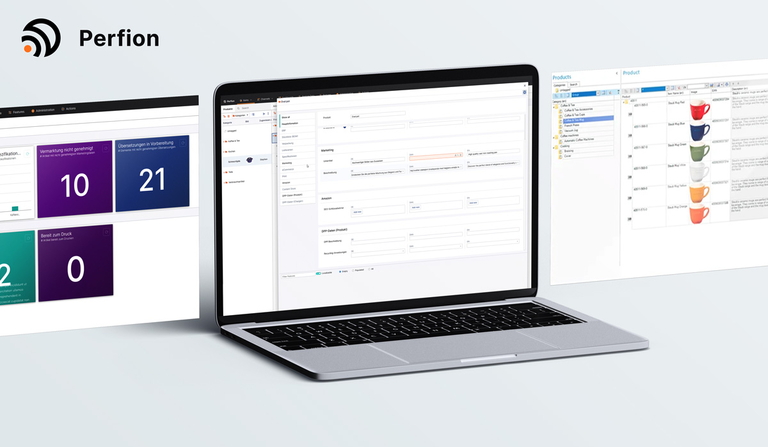
Perfion PIM interface on laptop with dashboards and product data view for efficient content management

Where multilingualism most often fails in B2B and how Perfion and Shopware solve it better

Multilingualism rarely fails due to a single major mistake. Usually, it is many small breaks that add up and quickly become visible in Shopware. Especially in B2B, this is critical because customers make decisions based on technical details, and missing information costs trust. Typical stumbling blocks with non-centralized data maintenance are:

  • Attributes incomplete for each language
  • Filters and product comparisons are therefore unreliable.
  • PDFs linked in the wrong language
  • Variants do not correctly pull documents Categories per language incorrectly named
  • Assignments not consistently maintained

Perfion PIM helps because product data, media, and documents are centrally structured and language versions are clearly assigned. Thru the connection of Perfion and Shopware, this content reliably reaches Shopware, ensuring that each language version remains consistent and the maintenance effort does not explode with each additional market.

What the Perfion-Shopware Connector specifically enables for multilingualism

The goal is for each language to have the same quality standard. In Perfion, for example, it can be specified per product which texts are required in which language. This way, not just a continuous text is transferred, but a complete product presentation that works for each market. Shopware thus receives product pages that are content-wise coherent and do not appear as an after-the-fact translation.

ℹ️ Due to its UTF8 capability, Perfion manages all characters of different languages.

This is also relevant for variants. Variant logic is often language-independent, but variant names and attributes are not. If variants are cleanly modeled in Perfion, the corresponding linguistic designations can be consistently maintained. Thru the Perfion-Shopware Connector, this content arrives in Shopware without the need to manually recreate each language. Especially with large variant matrices, this is an enormous advantage.

Another point is the timeliness. In B2B, specifications, standards, scope of delivery, or compatibilities change. If a change is only implemented in one language, risks arise immediately. With centralized maintenance, changes are cleanly applied across all language versions.

Data Quality Gate so that every language meets the same standard

With a Data Quality Gate, you define a fixed checkpoint in the process that ensures product data meets established quality criteria before it is passed from Perfion to Shopware. You can think of it like an automated barrier. Incomplete or erroneous data is blocked; only clean datasets go live. This reduces follow-up inquiries, prevents gaps in individual language shops, and makes multilingualism in B2B scalable because quality no longer depends on manual checks. In addition, you save costs because less rework is needed and processes run more smoothly.

  • A Data Quality Gate can, for example, ensure that mandatory attributes are maintained for each language.
  • Variant designations and attributes are consistent.
  • Data sheets, certificates, and PDFs are available in the correct language.
  • Categories and assignments per market are correct only approved content is updated in Shopware

Mehrsprachigkeit ohne Dauerstress für Ihre Teams

Multilingualism often involves different areas of responsibility. Product management provides data, marketing writes, translations are handled by agencies or internal teams, and sales need reliable product information in multiple countries. If Shopware is treated separately, it inevitably leads to inconsistent data and errors.

With Perfion and Shopware as a combination, the work shifts to where it belongs. Perfion is the system where content is created, reviewed, and approved. Shopware is the channel where this content appears and is sold.

This brings more calm in practice because responsibilities become clearer, and it saves time because less rework is needed.

Conclusion: Multilingual Shopware projects become easier when Perfion is the source.

If multilingualism is the growth driver, it should not become the process killer. Perfion gives you the central foundation to professionally manage multilingual product data. Shopware remains the strong channel for your markets. The Perfion-Shopware Connector connects both in such a way that language versions remain consistent, up-to-date, and scalable.

FAQ

The Perfion-Shopware Connector connects Perfion PIM with Shopware. Product data, media, documents, variants, and language versions are structured and transferred from Perfion to Shopware so that the shop operates with consistent information.

Depending on the setup, the following can be transferred, among other things:

  • Product master data and attributes
  • Short and long texts per language
  • Images, media, and documents such as data sheets
  • Categories and assignments
  • Variants and manifestations

A Data Quality Gate is a defined checkpoint that ensures data meets quality criteria before it is further processed or published. In the case of multilingualism, it prevents incomplete language versions, missing attributes, or incorrect documents from going live in Shopware.

Not necessarily. With clear approval processes and a data quality gate, it can be controlled for each language when content is considered "finished." It is important that Shopware receives only data that meets the quality standard for each market.

Especially for B2B companies with a growing range of products, many technical attributes, variants, documentation requirements, as well as multiple markets and languages. The more complex the product data, the greater the benefit of a central PIM base.

Yes. Perfion PIM is designed to use product data across channels, for example, for marketplaces, catalogs, apps, or other shops. This is particularly helpful if you want to avoid having data exist only "in the shop."